GDPR as a product feature
Most SaaS treats GDPR as a legal layer painted on after the product is built. That is GDPR theater. Done properly, GDPR is five places the user actually touches.
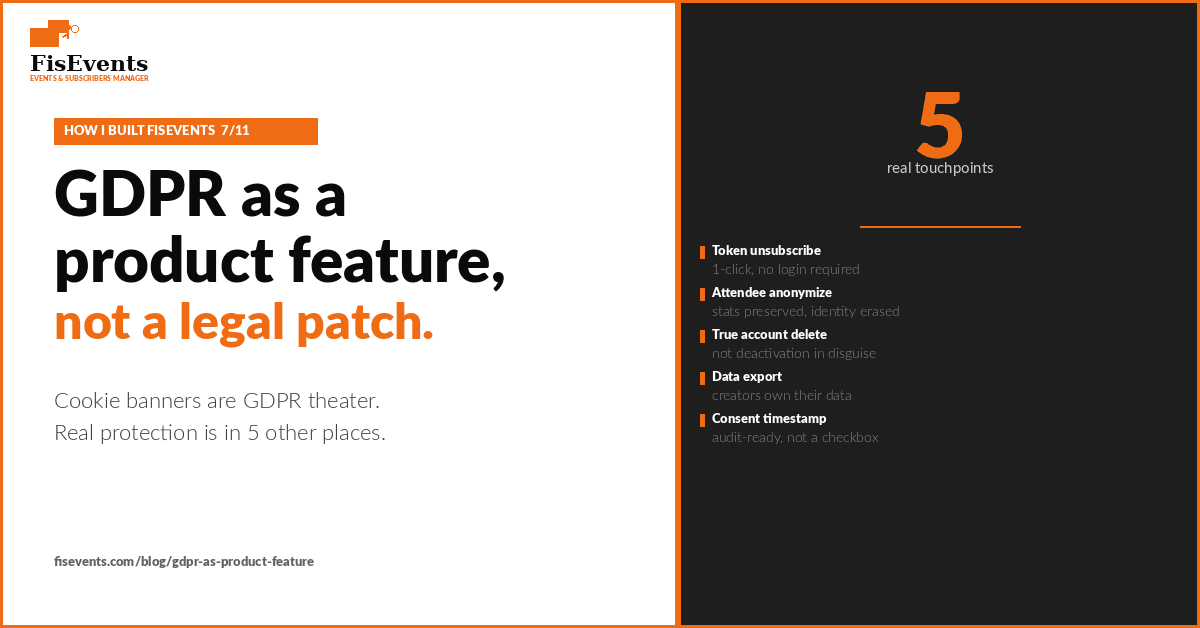
Most SaaS treats GDPR as a legal layer painted on after the product is built: a cookie banner, a 4,000-word privacy policy nobody reads, a "Contact us about your data" link buried in the footer. That is GDPR theater. None of the real protection lives there.
Done properly, GDPR shows up in five places the user actually touches:
-
Token-based unsubscribe. The unsubscribe link in every email contains a signed token. One click. No login. No "please confirm your password to leave." No platform-side capture of the click that closes the loop on tracking. If a user no longer wants emails, they get to leave without the platform learning anything new about them. Most products require login to manage email preferences. Requiring a login to unsubscribe is itself a form of surveillance.
-
Anonymization of past attendees. After events have run their course, the personal data of attendees has no business sitting in the database indefinitely. The pattern: replace name and email with an anonymized hash, keep the event reference, keep the count, lose the identity. The creator still sees "47 people attended the May retreat." Nobody sees who they were. Statistical history preserved, personal data erased. This is what the GDPR principle of storage limitation means in practice, and it is invisible to compliance auditors who only read the privacy policy.
-
Account deletion, not deactivation. When a creator deletes their account, the account is deleted. Not soft-flagged. Not "suspended pending reactivation." Not "anonymized for our records." Their data is removed, references in related records are anonymized or severed, and the user's email can sign up again later as a new account with no ghost history attached. Most "delete account" buttons are deactivation in disguise. The difference matters legally and ethically.
-
Creator data export. A button in account settings produces a bundle of every event the creator has run and every attendee on every event. The user can take their data with them, to any other tool, at any time. This is GDPR's right to data portability, and it doubles as an anti-lock-in feature. A platform that will not let users export their data is a platform that thinks it owns them.
-
Terms of Service acceptance with timestamp. When a user accepts the Terms of Service, the application records the user ID, the version of the terms they accepted, and the exact timestamp. If a dispute ever arises about what the user agreed to and when, the audit log answers in one query. Most products record consent as a boolean — "user accepted = true." That is enough to display a checkbox, not enough to defend in an audit.
None of those five features is exotic. None of them is hard. None of them is in a typical Stripe-and-NextAuth starter template. They are absent from most products because they are invisible from the outside — they do not generate metrics, they do not show up in landing pages, they do not sell themselves on a pricing comparison.
They sell themselves on retention and trust. The first time a user notices that the unsubscribe link works in one click without forcing them to log in, they update their model of the product. The first time a user requests an export and gets a complete CSV bundle in seconds, they tell other people. The first time a user deletes their account and verifies that the data is actually gone, they remember which platform respected them.
Data dignity is not a regulatory checkbox. It is a posture. The posture is felt by every user who interacts with the edge of the product.
For founders evaluating vendor risk, the GDPR question that matters is not "are you GDPR compliant?" That question receives an automatic yes from any vendor that has read the regulation once. The real question is "show me the five places where data subject rights are implemented in your product." If the answer is "see our privacy policy," there is no implementation. There is only a document.
The decision-maker takeaway: GDPR done as a legal patch over a finished product is expensive to maintain and brittle under audit. GDPR done as a set of small product features is cheap to maintain, scales with the product, and turns regulatory exposure into customer trust. The two approaches look similar on the org chart. They produce different products.
Next week: the SEO mistakes most developers make — including the one where staging environments leak into Google.
— Christian